Last night I held a firefly in my hands. I held it and marveled at how something so light could possibly shine so brightly, so fiercely, and for so short a time. Ever helpful, I scooped it off of the outside door and carried it to the side of the house within sight of the rest of his brethren. Fireflies, lighting up the yard under a canopy of stars. This is why I like living in the country.
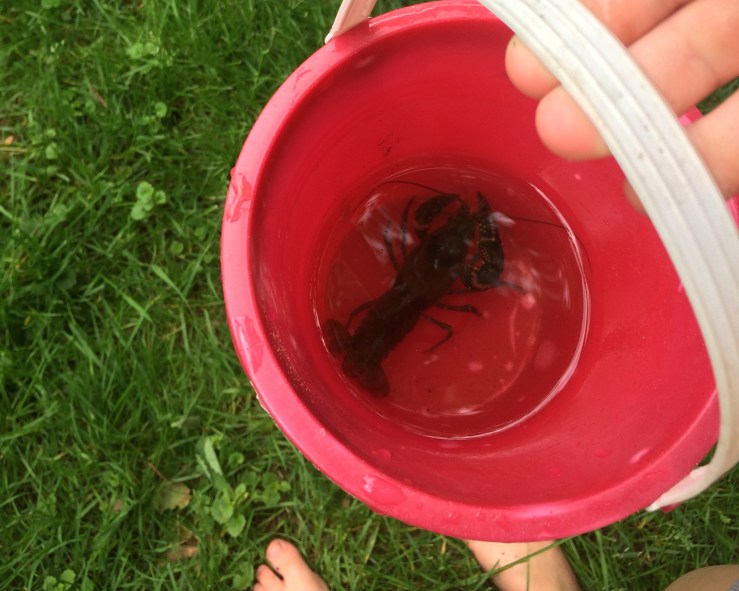
Last week I caught frogs and crayfish with my nephews. This week, I caught fireflies and bottle flies and several mice of varying sizes. I’ll be honest. The bottle flies and mice did not survive the encounters.
I’ve seen deer illuminated by headlights and turkeys stirred into motion only by the honk of a horn. I almost stepped on a garter snake, have seen painted turtles on the side of the road. I said hello to the neighborhood fox on one of my runs, but I haven’t seen the lynx since November. When I sat with myself in the woods, I closed my eyes and wondered what I’d do if I found myself eye-to-nose with a black bear.
No moose or ticks yet, either, but plenty of spiders, crickets, and flies of various biting capabilities.
A luna moth with a bent wing. Chickadees and crows and small birds I don’t know the names for. Hawks with their heads turned regally away – I’m not worthy of their notice.
Minnows around my toes. Gypsy moth caterpillars. Ants. So many ants.
These are all of the reasons I live in the country.
I was shuffling through some papers tonight and rediscovered the essay Bouyancy by Willard Spiegelman. Honestly, I don’t recall where I found it and I barely remember reading it.
But, it does cover some of the sensations I talked about in my previous post and, by the transitive property of ideas, makes me seem less weird.
An excerpt:
The swimmer becomes part of the element that supports him, part of an ever-changing geometry through which he slices and which then corrects itself as he moves past. The human body is 70 percent water, so swimming returns us to ourselves. The action combines fact (“grasp”) and process (“grasping”); it requires submission that then becomes liberation. You move beyond yourself and leave no trace. Swimming frees you from the world.
In 2005, one mile was no big deal. Now, nine years later, it’s a big deal.
Have you ever sat and watched someone swim even just 500 yards? It’s dull. There seems to be no adventure to it. No grand strokes of difference, just tenacious kicking. Swimming laps is sterile and monotonous, for the watcher and for the swimmer. The lanes do not change. The floor, if we’re very lucky, gradually approaches and receives, adding some visual interest and an indication of the passage of distance; something to show, at least, for the enormous effort of moving through water. Sound becomes white noise, drowned by water and exasperated by the funny way all pool buildings refract sound. Even sensation drops away. You can feel nothing but the current of your own momentum against your skin.
There is no adventure to be seen in lap swimming. But there is adventure.
Held afloat, made buoyant by a blend of momentum and body fat, the mind slips away. Your brain no longer has to think about holding your stomach in or wonder what that smell is. Instead, muscle memory takes over and your thinking mind relaxes. While your body is counting strokes between breath, the thinking mind suspends.
Is this the swimmer’s version of a runner’s high? If so, then I haven’t run far enough or fast enough to reach this state – balanced perfectly between the Id and Superego.
There’s some correlation between which thoughts come up the stroke. Backstroke makes me plan for future things, accomplishments that haven’t yet been. Breaststroke (my worst stroke by far) is where I face weakness. Freestyle is where anxieties are presented and summarily dismissed. Butterfly (my favorite stroke by far) is pure adrenaline; it’s where I stand up for myself. Butterfly is an efficient, powerful stroke; you cannot swim butterfly when you are at war with yourself. If you do not believe that you are efficient and powerful, then the stroke will punish you.
At least, I always feel efficient and powerful after I swim butterfly. But, people who love to swim butterfly are at least a little bit crazy. I honestly don’t know if I was any good at butterfly back in 2005. I think I was okay. Not amazing, but okay. Even at my most competitive, my times didn’t really matter. I just loved swimming butterfly. I was definitely crazy.
This past one-mile swim, during my 50 backstroke I thought, “I bet I’m the right kind of crazy for triathlons.”
There is adventure in swimming laps. You just may not see quite yet.
You know those rainy days when you find yourself questioning?
Your work. Your play. Your relationship with other human beings. Your relationship with yourself. Come on. You know what I’m talking about. The days when one question tumbles into ten, a hundred, more than you care to count.
On that day, I highly recommend going out to enjoy the rain. Stand in the parking lot with your head tilted back, face to the sky. Close your eyes and feel the spaces between the rain. Feel the impact of the air, feel the comforting coolness of the water as it slides into your eyes and runs from jaw to clavicle.
Forget for a moment to pull your rain coat over your head. Forget that you’re supposed to be inside cooking dinner or returning phone calls. Forget the spreadsheets, the grocery list, the laundry piled in a disheveled heap on the bed. Forget.
On my first visit back to Illinois since the tornado turned my parents’ neighborhood into toothpicks, I thought I was going to have Opinions. I would share those Opinions here, going on a tirade about, presumably, the foolish folly of man against nature. The biggest surprise of being back here is that I don’t have an Opinion, let alone Opinions.
Riding around the neighborhood, some houses are aesthetically repaired to their original big-box-store perfection. Others, just two doors down, have holes in their roofs and entire walls hanging precariously off. The juxtaposition is bizarre.
From the saddle of my beautiful borrowed bicycle (a loaner from the local bike shop – the Specialized Ruby), there’s nothing to say that Robert Frost hasn’t already said: “In three words I can sum up everything I’ve learned about life: it goes on.”
Yesterday I watched a rabbit take shelter from the rain under the neighbor’s red Honda.
Whether we rebuild or not, life goes on.
–
On an entirely separate note Dad bought me my first pair of cycling shoes as a “thank you” for finally buying my own car and therefore getting off his car insurance. The shoes (Specialized) match my black and purple Louis Garneau kit. I’m That Cyclist now, and I have no intention to apologize for it.
Now I need a bike rack so that I can transport the bike somewhere that isn’t uphill in every direction.
It’s common wisdom that two people engaged in a romantic liaison should never under any circumstances teach one another to do anything. From running to poker, nothing good can come of this.
Or can it?
R and I have survived the winter of sharing our sports with one another. Here’s how we did it without one stabbing the other with a sharpened ski pole.
1. Have an actual interest in learning the sport.
I’m serious here. Reasons you should learn a sport from your lover: you want to play that sport and want to play it with them at some point in time. Reasons you should not learn a sport from your lover: you want to keep an eye on them, you don’t like them having their me-time, they’re forcing you. These are bad bad bad bad reasons and will only make the experience miserable.
I dated someone who forced me to run with him. It was the worst. I didn’t start running again until nearly 3 years after we broke up. Why? Because it was torture. Don’t torture; it’s mean.
2. Establish a teacher-student relationship that is different from your partner-partner relationship.
During teaching time, let the teacher teach and let the student be a student. Don’t just acknowledge that the teacher knows what they are doing, take it for granted. Believe it from your frostbitten nose to your tennis-shoed toes.
For us, this was pretty easy. We’re both athletes used to being coached, for one. But, perhaps more importantly, we do a pretty good job of communicating our lesson needs to one another. Teaching tennis is part of R’s job. It’s what he does, and he does it quite well. When it came time to teach him to ski, I took cues from our tennis lessons on how to talk, how to explain things, and how to listen.
This isn’t to say it’s always easy. R, for example, does this thing called “talking” which drives me nuts. I can’t listen, wind up, aim, and hit a ball of yellow fuzz all at the same time.
3. Know your limits as a teacher.
I can’t speak for R here, but I can speak for myself. I have never taught skiing to anyone. I am navigating this teaching thing by guesswork, relying on examples and tricks I either overheard or vaguely remember from the two winters I raced. I know I can’t be his only instructor, which leads me to —
4. Allow and encourage them to learn from someone else.
You’re not the only person in the universe, and you may not be the best teacher for your lover. I’m not the best person to teach a complete newbie how to ski, so I helped R get set with rental gear and gave him a good luck kiss before he went off to take lessons from a properly trained professional.
In tennis, a shoulder injury prevents me from doing a normal overhand serve. The person who taught me my serve wasn’t R, but one of our friends who happened to know enough about tennis to suggest it. R don’t take it personally that someone else’s boyfriend fixed my serve.
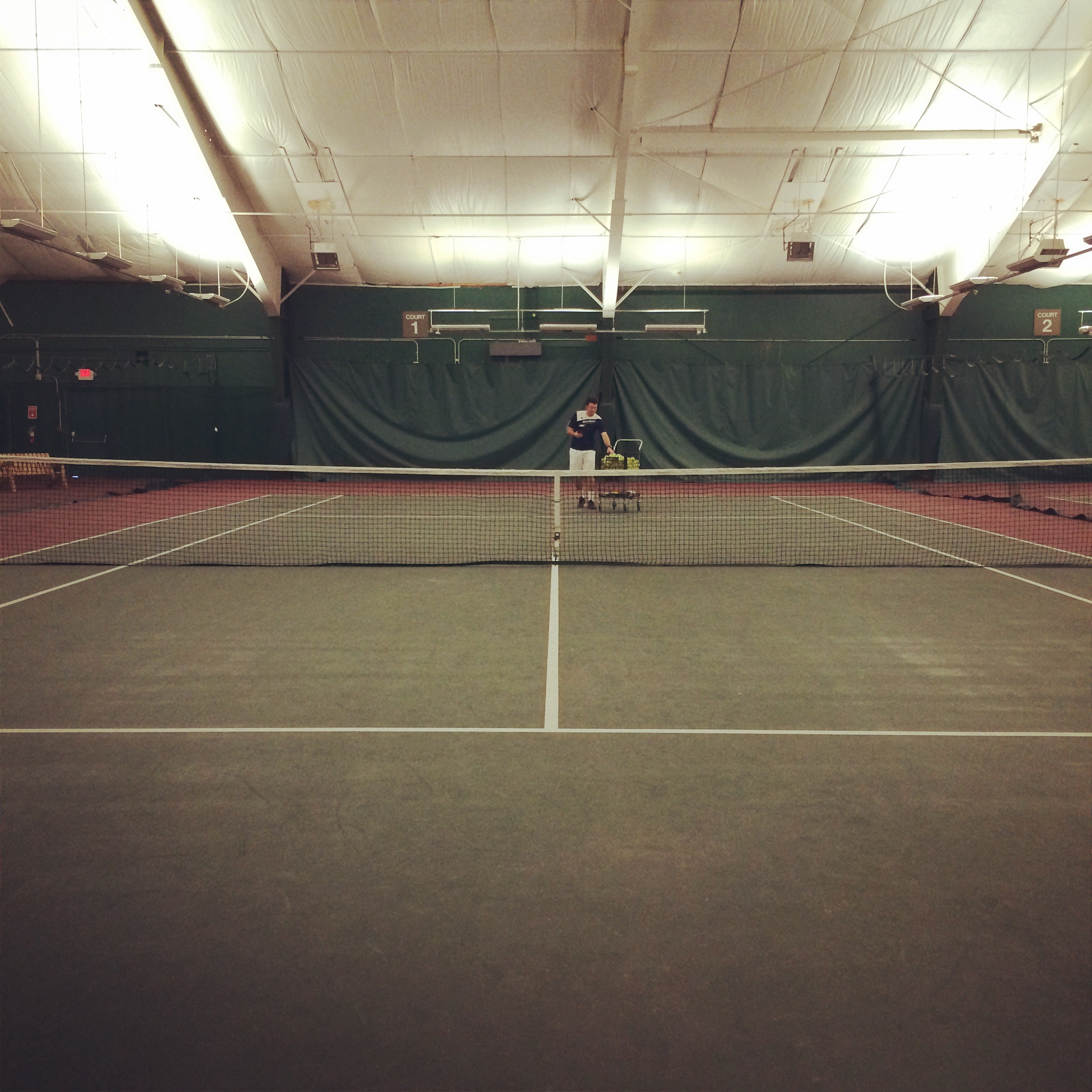
Coach on the court. Coach’s girlfriend, not paying attention. Per usual.
I use the word fixed very loosely here. My serve is terrible. But at least it doesn’t feel like my arm is tearing through the socket every time I try.
5. Kiss them when they’re happy, kiss them when they’re pissed.
Unless they don’t like kissing. In which case why are you dating this person?
Here, basically, no matter what, be positive. If they’re driving you nuts, be positive. If they’re getting ticked at you, be positive. Tell them that they’re doing great. If they really aren’t doing great, give them a kiss and say, “That’s enough for today.” Maybe they had a bad day. Don’t make it worse by forcing them freeze on the chairlift or hurt themselves by flailing frustratedly at a ball of fuzz.
—
That’s all the advice I have. Do you have experience teaching your loved one, or being taught by them? Funny stories, epic fails, or brilliant victories? Tell me about them. 🙂
This morning I woke up alone in the house for the first time since I dropped the first of many bags in the bedroom back in January. Per usual, I slept too late, letting dream and reality blur hazily around the edges. More and more often, I dream that I am getting up and going down stairs, going about my morning routine. It’s only the lack of sensation that tells me I’m still sleeping – no feel of bare feet on the carpet, no feel of clothing against my skin.
When I finally draw myself up, I make a full press pot of coffee and sit on the porch steps with the latest issue of Outside Magazine on my knees. I take long gulps of coffee. I pretend I can’t taste the one-day-too-old flavor of the milk in my muesli.
Then, I change into my matching cycling kit, which I laid out on the kitchen counter the night before. I do this same thing the night before my first ski day of the season.
As I pounded slowly and (honestly) painfully up the hill, I thought – how on earth did I get here: to the point at which I lay out my Louis Garneau shorts, jersey, and matching gloves next to my Louis Garneau helmet, hand-me-down sunglasses, and small clip-on mirror. I still don’t own bicycle shoes, but I did spend $40 on air pump yesterday, so that has to count for something.
This was my Easter Sunday, this was my church. A too-short, too-difficult bike ride followed by Outside Magazine on the back patio, bikini-clad with a whiskey lemonade. The good parts, you see, are really, really good.
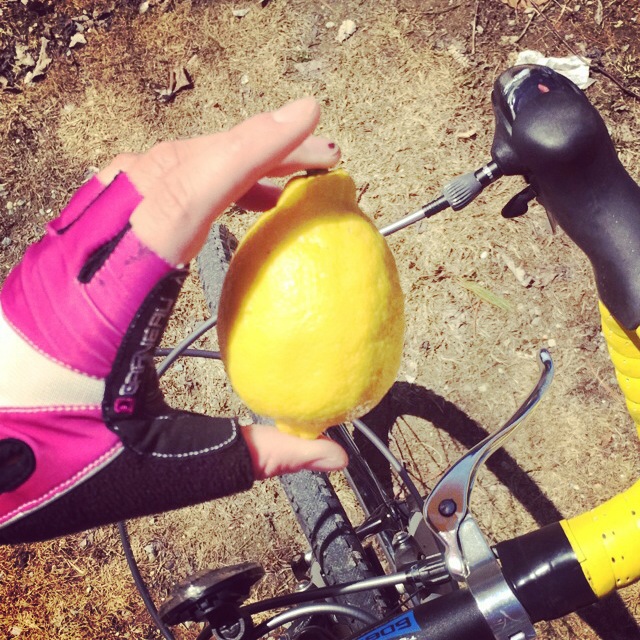
“Greetings, shopkeep. I would like a single lemon. The finest lemon you carry!”
I haven’t forgotten about this. I haven’t left this place behind, forgetting it like I’ve forgotten so many others. For once, I haven’t forgotten the place, but the words.
That’s it, really. I just don’t know what to say.
Are pictures really worth a thousand words? Well then, here’s a picture.
I’m not one for flowers, really. Roses have very little appeal and while I like the look of lilies, they (like cats) hurt my eyes within a few minutes of exposure. That said, once a year, I like tulips.
The bouquet I bought yesterday sits on the kitchen counter in the glass jar usually reserved for muesli. They are pink and yellow and just starting to bloom.
The snow is thick on the ground and the days are still so cold that an hour above freezing is a welcomed reprieve. But it is spring. In a few weeks, the mountain will close and I will regret ever thinking of summer.
In the meantime, I will change the tulips’ water every day. I will fill the glass jar halfway with cold water because I’ve heard it will make them last longer.
DepressedAlien.com is a really good comic. Very much worth reading through a few panels.
This single-panel comic turned up multiple times last week, both on my FB newsfeed and in causal conversations with friends. I laughed the first time I saw it. The second time, I giggled. The third time, I started to wonder. Why on earth do I live where the air hurts my face? And why on earth do I have no intention of ever leaving a place where the air hurts my face? Simple.
Because I know how to keep warm.
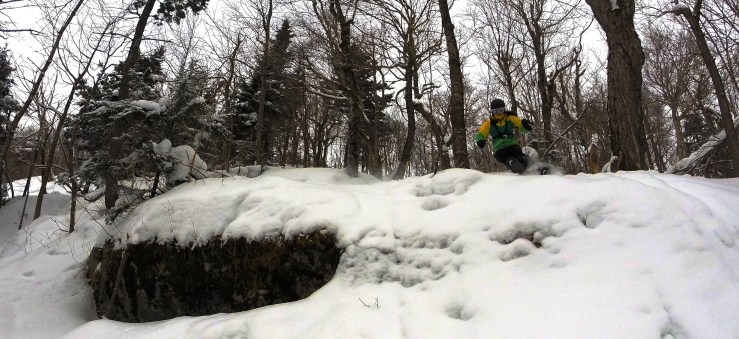
I ski the trees and find myself sweating at 20°F. I turn my face to the sun when I stand in the woods. I wrap myself in flannels so broken in they’ve lost their structural integrity, but not their warmth. I drink whiskey with my friends, letting the liquor warm our throats and our tongues. I am carried away by the sight of the stars burning fiercely through the cold night sky. Then, later still, I curl up beneath a layer of down and fall asleep to the peculiar silence of falling snow.
There’s a strange pleasure in having bruised knees and scuff marks on your shoes. Nothing new stays new-looking long and most of the dents and tears don’t even come with good stories, just a simple, “Oh, I don’t know. I must have tripped.”
Clumsiness comes from some combination of head-in-the-clouds inattention, awkward physical comedy, and, if you’re like me, a touch of recklessness.
T-minus 10 minutes to impact.
Last week, I went on a short snowmobiling tour. Just ten minutes after starting, I crashed the sled and was upside down in a ditch of soft powder, relaxed and reclining with my right foot stuck under the machine while the guide and Ted came sprinting to help me. They were, reasonably, totally freaking out. I was totally not.
When the sled was righted and I sat back down on it, the guide asked me “Are you okay?” I said yes. He repeated himself. I repeated myself. And I wasn’t lying. While I’d been nervous for the first leg of the tour, after flipping the sled, I felt much more calm and in control.
Falling, it seems, has the strange effect of making me less afraid.
I was terrified of road biking until I had my first big fall, scraping skin from both of my arms and leaving a welt on my hip as big as an egg. I was afraid of sailing until I capsized in the middle of Seymour Lake all alone, fighting against a too-strong wind and trying to get back to shore. Afraid of dropping the cliff until I land, too far back on my skis and forced to bail.
Because the impact is never as bad as my fears, I now know that while I’m afraid of falling, I’m not afraid of the fall itself. This makes me reckless, because I know that once I fall, the fear dissolves. Once I fall, I take stock of my body, stand up, and dust myself off. I brush snow from my shoulders, gently flick rocks out of my wounds, or shake water from my eyes. A less reckless version of myself would not have crashed that snowmobile. The less reckless me would have played it safe, would not have pushed herself to try to keep up with the more comfortable and more experienced members of her party. She wouldn’t have dared to try so hard. She also wouldn’t have enjoyed herself anywhere near as much. (Or had such a good story to tell, which, unfortunately, seems to be the story that is circulating amongst Stratton employees. “Liz from Marketing? She’s the one who flipped the snowmobile, right?”)
The most important thing to learn when trying something new is how to stop (this being my issue with the snowmobile. I’m accustomed to my right hand controlling the brake, not the accelerator). The second most important thing is how to fall.
Because you will fall. If you don’t, you’re not trying hard enough.
This reminds me of watching my nephew learn to ski. He fell a couple of times, but every time he did, my brother, my dad, and I immediately roared with laughter. “Nice one!” We’d yell as we scooped him up and placed him back on his skis. “That was awesome!”
We’re teaching him that falling is more than just no big deal, it’s downright fun. Even if it leaves you smarting, wincing, crying in pain, falling is fun.
Now if we turn this into a metaphor for life–? Puts quite a few heart-and-headaches into perspective. After all, if you’re not falling, you’re not trying hard enough.



 Sidecountry Living